The only half-way tangible marker I try to hold onto for my creative work is improvement. Maybe this album is deeply flawed, but it must feel like it’s less deeply flawed than the last one.
In that sense, I’m trying to make this a learning experience — as I pick up new skills and then try to refine them — and to do that, I have been led by skills I have learnt from others.
I’m going to write about the effect of three of these key people*, who have each had a massive effect on my musical development.
Though each of these people are more or less close friends of mine as well as collaborators, I want to focus on their roles as mentors here, and how that part of our relationship has impacted me.
[*not their real names, for their privacy]
Stephen
If you had asked me back in 2000, about what I thought studio production is all about, I would have told you it was none of my business.
But that was dishonest — I would have been quietly thinking that it was technically and financially beyond me, and I would have been trying to mask this limitation by concentrating on my obsession with Lo-fi (mostly via Sebadoh).
In reality though, I was already straining at the leash, looking for new spaces to work in, and coming to see that even bands like Sebadoh were still making thoughtful production choices, as much as pop music (but with a more profound emotional effect).
So I met Stephen at just the right moment, and he opened my eyes to some incredibly important aspects of making music.
Firstly, he gave me a solid grounding in studio production principles — things like what compression can do (for better or worse), how to understand reverb as a creative tool, and the possibilities that can open up when you allow yourself to mix synthetic drums and synths with “real” instrumentation. These are tools I still use consistently on a daily basis in my production work.
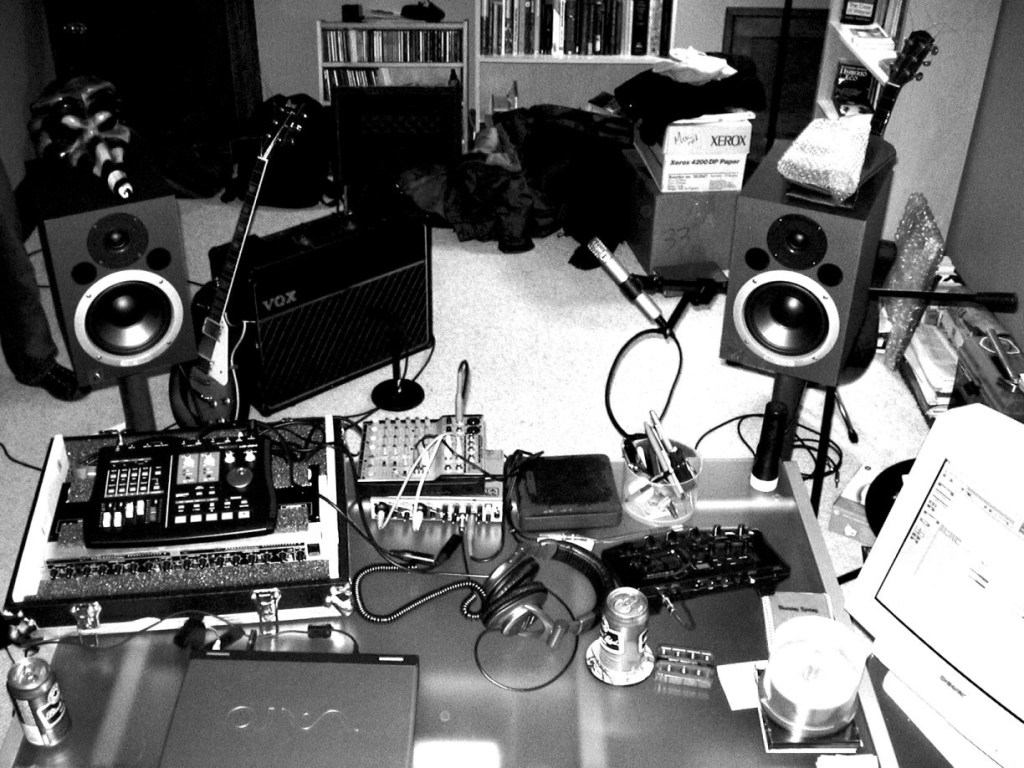
The home recording set up I build with Stephen, in 2003.
Even more importantly, Stephen showed me that, if you are really focused and dedicated, you can create music “in the box” that sounds far better than “should be allowed”. He taught me that the seemingly massive differences between home-studio and world-class gear are often significantly offset by taking great care in your work.
This revelation was born out when, working in studios years later, I was able to use truly amazing gear, and I noticed that its single biggest differentiator was that it sounded great immediately.
At home I had to wrestle hard with my equipment, but when I did, I could eventually achieve somewhat similar results.
But wrestling was exactly the point (and the fun), in my work with Stephen.
I’m certainly not saying we made professional-level recordings, but we made interesting things, and I was no longer intimidated out of approaching that goal.
We also revelled in the process of making the studio an instrument, and since then I have always felt confident that studio skills and achievements are far more about things like commitment, focus, reflection and attention to detail, and far less about wealth — a profoundly empowering revelation.
Leopold
When I started working in “real” studios, I was mentored by a real professional — Leopold — and he gave me new ears.
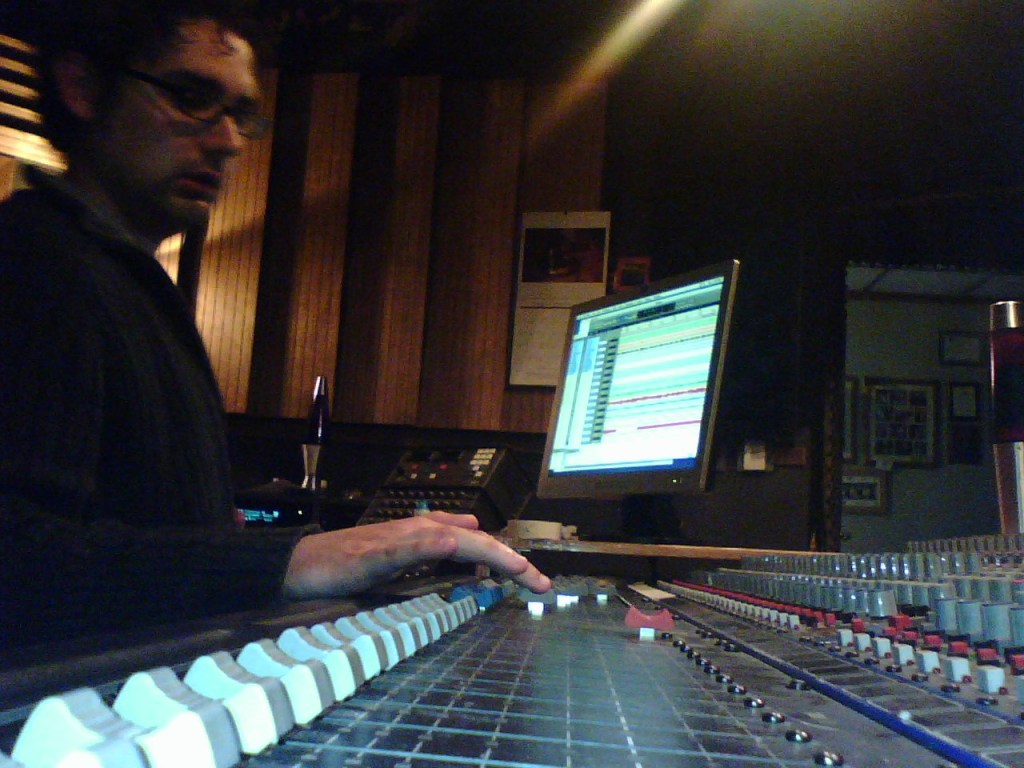
Working to improve, in a pro-studio.
Even when I cared about what I was producing, until this point I had never learned to care as much about tone over tune…
The width of a kick drum’s sustain.
The tonal difference between placing a 421 on the top of a snare versus under it.
How adding the “warmth” of a 2” tape reel (which everyone is always going on about, but usually pretty vaguely) actually adds to a mix.
These many underlying differences led to huge outputs. I remember Leopold offered to do a mix of a band I had tracked and mixed already, so I could see what else might be possible.
Playing his version back, in my car on my way home from the studio, was a rude awakening. It was live, present, clear, warm, and aggressive in ways that sent me back to the drawing board.
He showed me that I was only at the outset, and (once I picked myself up), it has remained good to be aware of the distance yet to travel.
Molly
By the time Molly and I started to make music, I was pretty comfortable with my largely “in the box” model for song construction. Working with her allowed me to push myself to reconnect with sound over the air.
I had fallen into the habit of playing all my guitar parts DI (direct in, to the recorder), because it gave me lots of control and flexibility to concentrate on tone separately from performance).
Molly had me roll re-amping into my production process, so I could resuscitate the energy of loud amps in my recordings — specifically my ‘68 Vox AC10, which had been gathering dust in a corner.
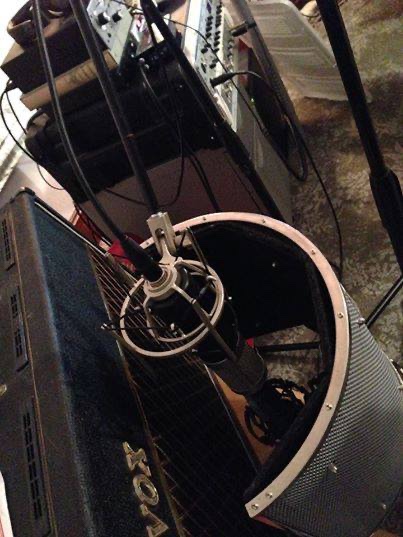
Re-amping testing, with my old Vox AC10.
This allowed me to reassess, in a more balanced way, the contrived divide I had forced between what was or wasn’t “live”.
Molly and I went to great lengths to create this kind of creative space, eventually renting a converted barn to work up some demo’s, with lots of re-amping in our process.
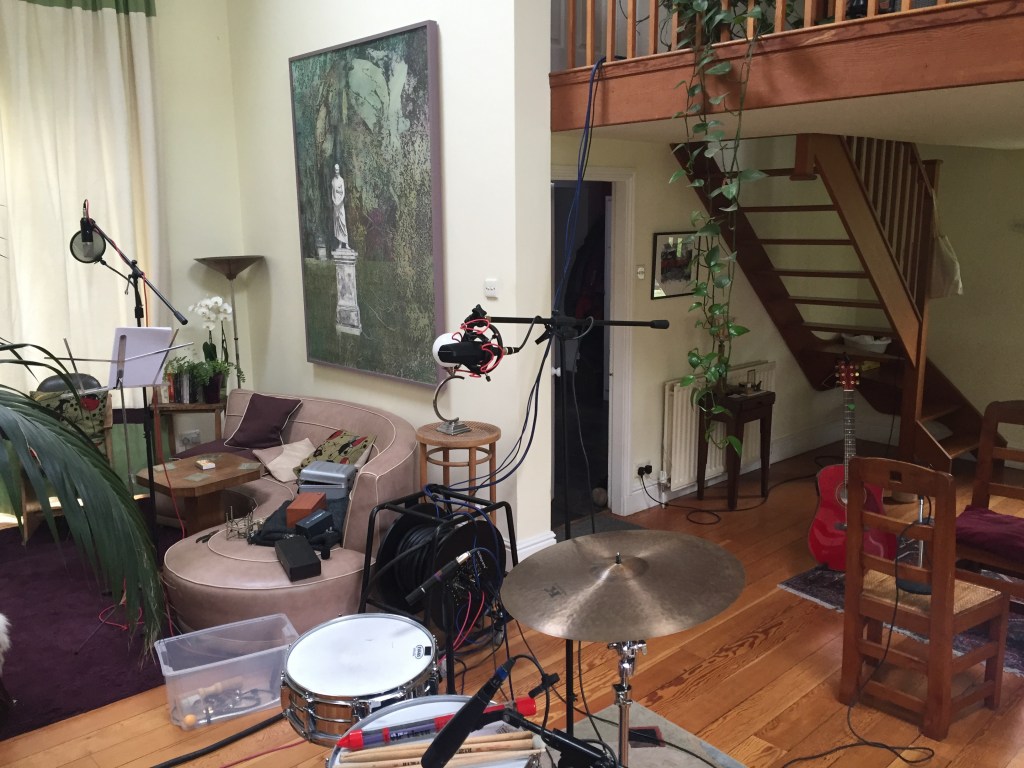
The “studio” Molly and I set up, in Hebden Bridge, over a weekend in 2016.
 That Night with Golding